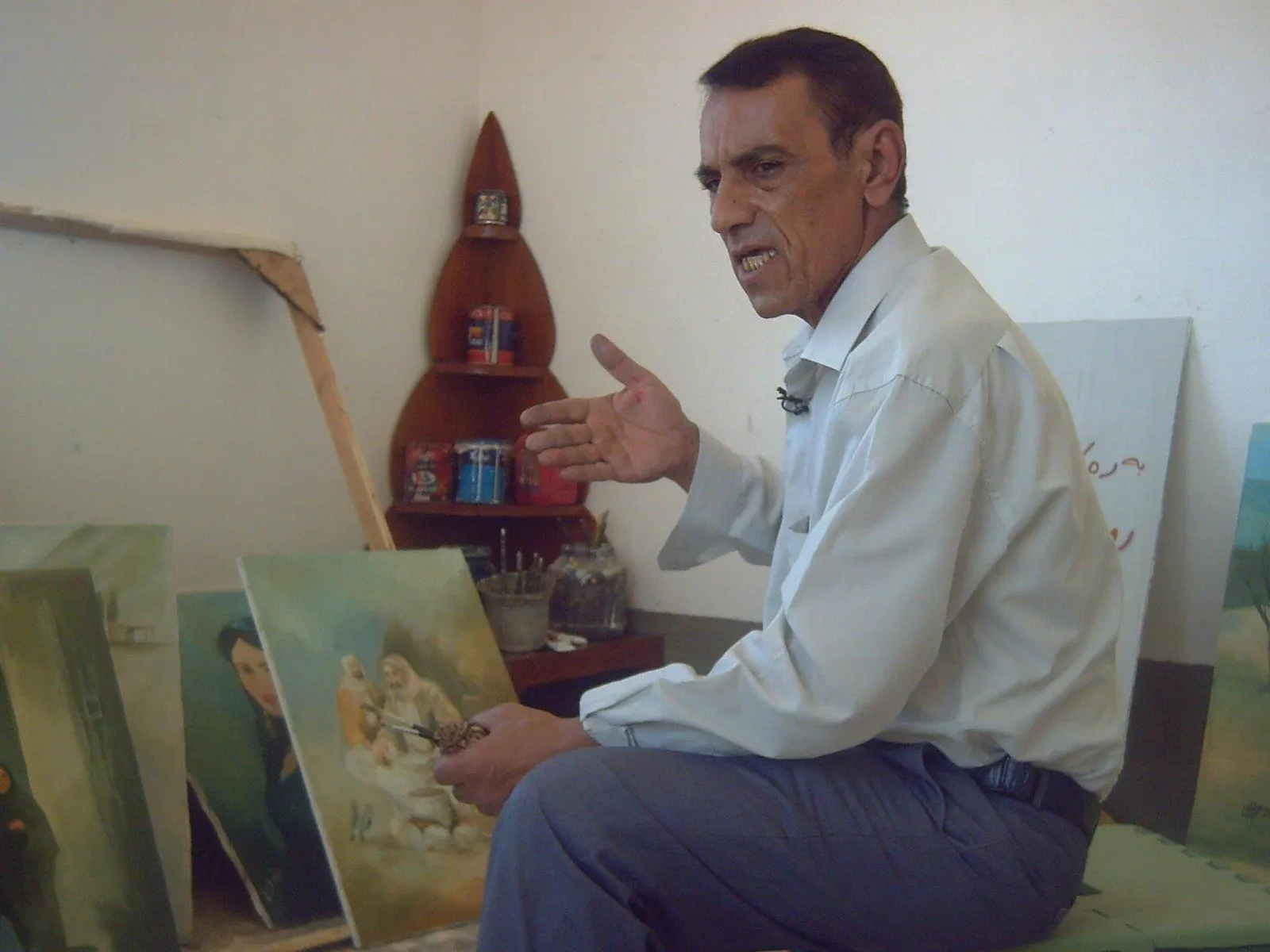
Younis Gauguin

Painter · Sinjar, Iraq

YounisGauguin

يونس جوجان

He has painted the mountain for more than fifty years. His paintings reached Miami, Germany and Sweden, yet almost nobody knew where to find him. Until now.

See the paintings Scroll slowly. It is a long road.

Photo from an interview with Rudaw TV.

The name

In Paris, there was a painter called Gauguin.

In Sinjar, there was a man called Jojan.

The second one was his grandfather.

GauguinParis Jojanجوجان · سنجار

Years later, the grandson saw the Frenchman's paintings. Brave colour. Faces the colour of the land. People who belong to it.

He thought: I know these people. They live in my village.

So he kept his grandfather's name, and borrowed the Frenchman's colour.

Sinjar

The boy

His father built houses. Younis drew his father.

He was born in the arms of the Sinjar mountains. He drew his brothers next, then his friends. Anyone who would sit still long enough.

At Sinjar Secondary School, two teachers saw it first: Duraid Khalil Rajab Al-Rawi and Muayad Salim. After that, every school exhibition ended the same way. He carried a prize home.
1980s

The teachers

He thought he was good. Then he met the others.

At the Teachers' Institute, under the master Hazim Jiyad, and in the university studio, he sat beside giants.

Najib Younis, who painted Yezidi life with fierce realism. Dirar Al-Qaddo, another realist. Rakan Dabdoub, who painted volcanoes erupting over human bodies.

All three are gone now. He still talks about them.

1981

The fig trees

Every spring, Mosul held a festival of floats.

He helped make the float for the people of Sinjar. It was covered in fig trees.

He spent two years in Ziad's office for calligraphy and drawing. Iraqi newspapers wrote about his wall posters, shown in the forests of Mosul.

That year he married. She had been one of his students.

1983

The farthest village

They sent him to the farthest village they had.

He says it was one of the best times for his painting.

Mud houses. Sheep. Traditional dress. A 4B pencil in his pocket. He drew every old man's face and every young girl's, and there his love of watercolour grew.

1988

The workshop

Back home, he helped build a place for makers.

With Kifah Mahmoud and Ali Hussein Zakar, he was one of the founders of the Sinjar Handicraft Workshop, and he ran its fine art section. Then came his own office for painting and Arabic calligraphy.

Murals in more than one province. Paintings that travelled further than he ever did.

  • Miami
  • Germany
  • Sweden

Sinjar

The neighbours

Sometimes his neighbours could not pay.

He painted for them anyway.

Then he wrote the banners for their celebrations in calligraphy, and that paid for the paint.

He gathered the young people of Sinjar and taught them to paint. Their work hung in the Employees' Club hall, with the support of the Lalish organization. He drew cartoons about the daily life of ordinary people for the newspaper Lalish in the eighties, and for Sawt Al-Fallah today. Once, he painted a mural twelve metres wide.

2014

The other direction

In 2014, the road went the other way.

Everyone left the mountain. He went to Erbil, carrying what he could.

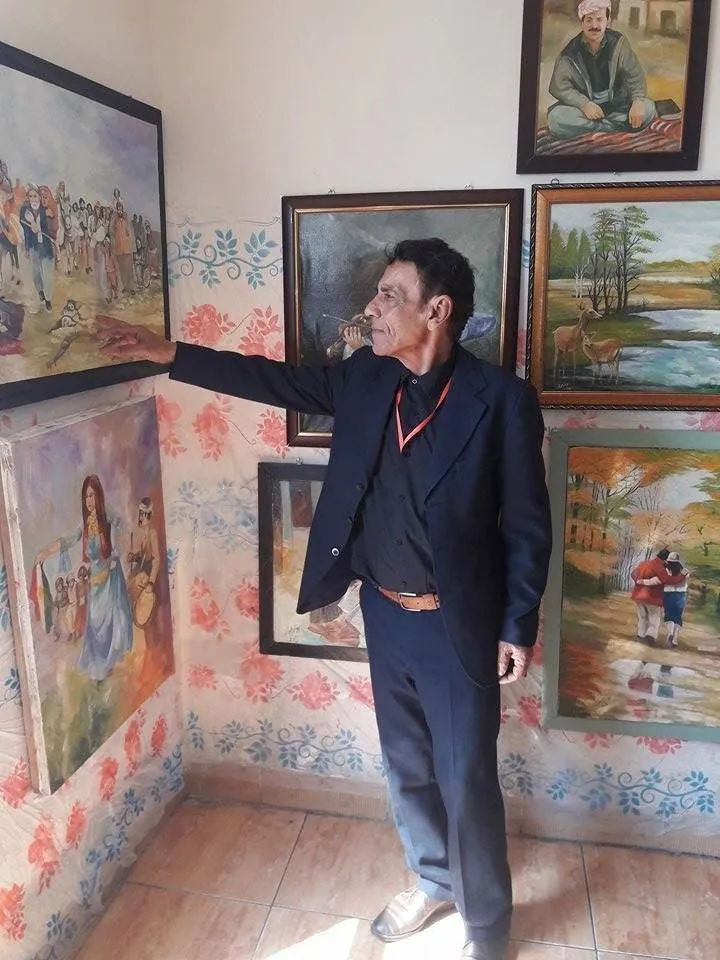
He hung small exhibitions there. No opening. No invitations. Only the paintings on the wall, and him standing next to them.

Younis Gauguin pointing at one of his paintings at an exhibition in Erbil
Erbil. One of the small exhibitions.
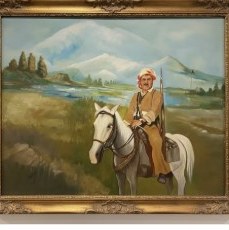
A horseman on a white horse before a snowy mountain, painted by Younis Gauguin in 1972

1972

Some paintings are not for sale.

As a young man he painted a horseman, a white horse and a mountain, and gave it away.

Fifty years later, the writer Kifah Mahmoud still remembers it as one of the most beautiful paintings in the room.

This one stays. The others can travel.

Today

Today he is retired. The paint costs more than his pension.

So he paints less than he can.

Every painting that leaves his house buys the colours for the next one.

See what he has painted

The works

Each painting is one of a kind and signed by hand. Reserve one, and it travels from Iraq to wherever you are.

Hanging the paintings…

· Keep scrolling, the wall moves → See all paintings

How buying works

Price
Reserving
Payment
Shipping
Final sale
Answers

The film has no ending.

He is still painting.

“Success does not come by chance. It comes from hard, continuous work.”

النجاح لا يأتي صدفة، بل هو نتيجة لعمل شاق ومستمر

Write to the painter.

Reserve a painting, ask about one, or send a photograph of someone you love and ask for a portrait.

His son Ibrahim reads every letter and answers personally, in English or Arabic.

Not ready to write?

Leave your WhatsApp or email. You will hear when a new painting is finished, and nothing else.

We add your country code for you.